Scuba-Diving · Indonesien und Philippinen

► Deutsch

Octopuses at work

Octopuses always fascinate divers. Watching them at work is magnificent. They are especially well-suited for video recordings.

This video was created during my dives in October 2025 in the northern tip of the island of North Sulawesi, west of Manado.
Some excerpts from the video

Identifying the species of the animals isn't easy for me, as I'm not an expert. Dive guides are a great help here. Internet help is also available, but it's often difficult to find the right species.

If you find any discrepancies, please let me know. The best way is via E-Mail.

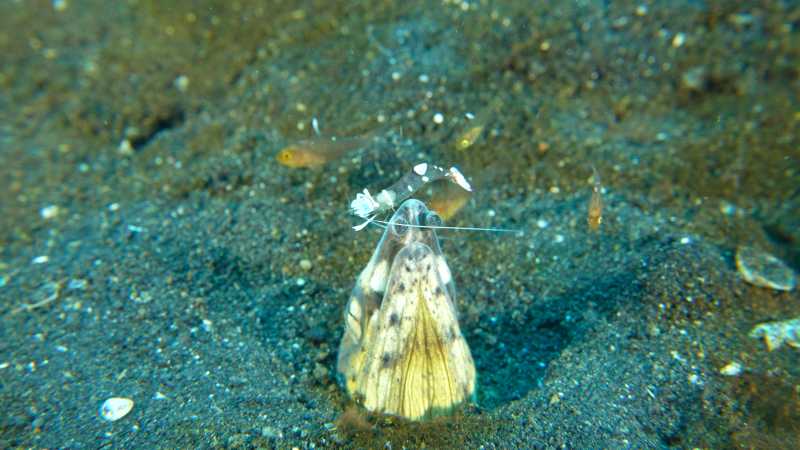
Snake eel
It is buried in the sand. A cleaner shrimp is cleaning its surroundings. Snake eels are a family of fish found worldwide in tropical to warm-temperate waters. These eels are bottom dwellers and often hide in mud or sand during the day, hunting for prey at night. They feed mainly on crustaceans and small fish. Many species lack fins, which helps them burrow into the substrate like worms. The eel pictured could be a sand snake eel (Ophichthus altipennis), which lives in coastal regions and can grow up to 103 cm long.
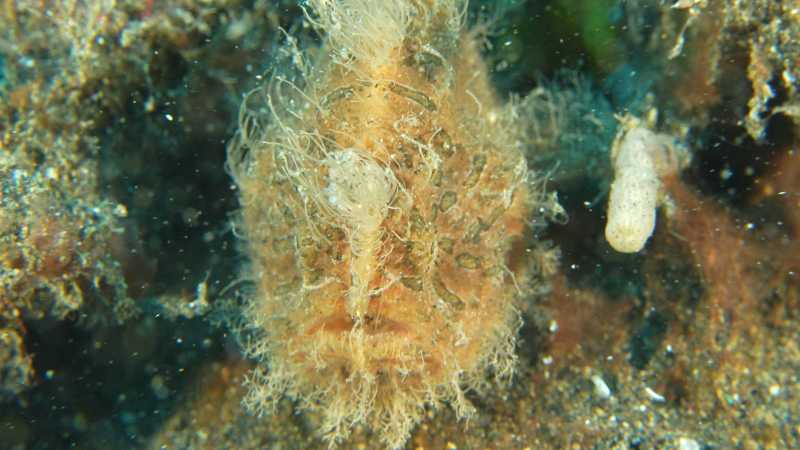
Hairy Frogfish
The body is covered with skin appendages (dermal spinulae) that resemble hairs. The fish's coloration and pattern are extremely variable, ranging from yellow to brown to green, to adapt to its environment. The fish is a predator that lures its prey with a rod-like bait (illicium).
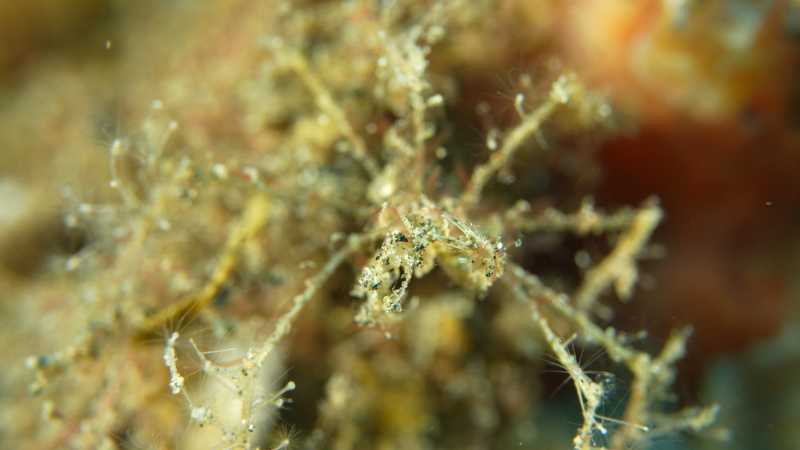
Ghost Crab
This crab is known for its hairy, fuzzy appearance, created by algae that it attaches to itself for camouflage. Its coloration varies from gray to yellowish to reddish-brown, sometimes with white markings. The triangular carapace (back shell) can reach a length of up to 16 mm. The crab has very fine and slender legs, with the tips of the last two pairs curved and sharply pointed.
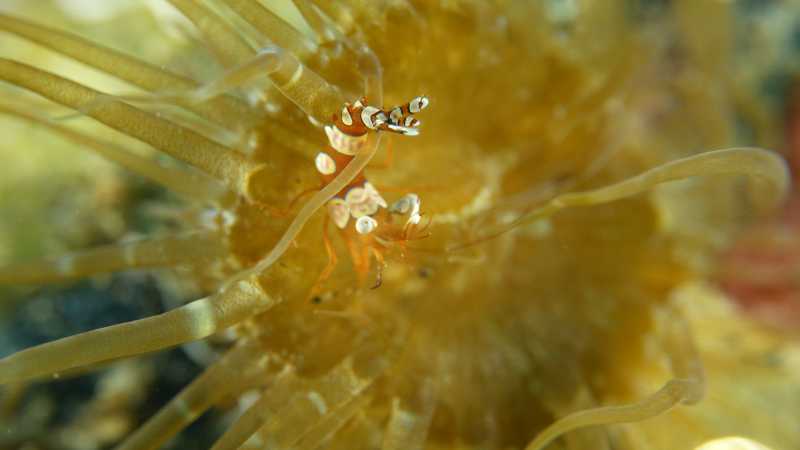
Peacock Anemone Shrimp
This shrimp species is also known as the glass anemone shrimp. It lives in symbiosis with sea anemones and is immune to their stinging cells. The body is transparent with large white spots, and the tail fan has four to five orange spots with a black ring. The shrimp are typically about 3 to 4 cm long.
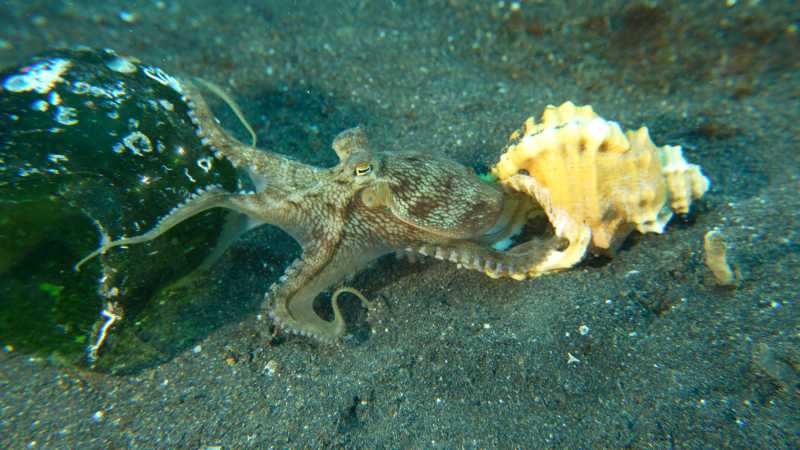
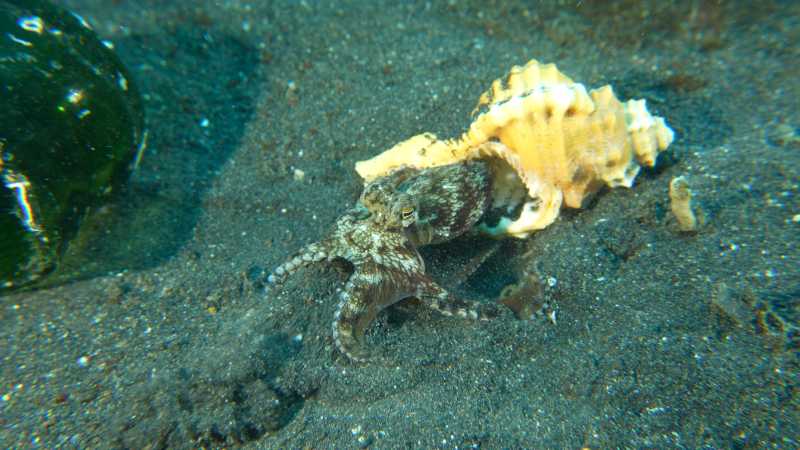
Blue-Lined Octopus
Known for using shells as shelter. The veined octopus is known for its intelligent behavior. It uses discarded coconut or seashells as portable dwellings. They are able to dramatically change their color to camouflage themselves or to send warning signals when agitated.
Blue-Lined Octopus
The blue-line octopus belongs to the family of blue-ringed octopuses and is highly venomous; its bright blue markings appear as a warning when disturbed.
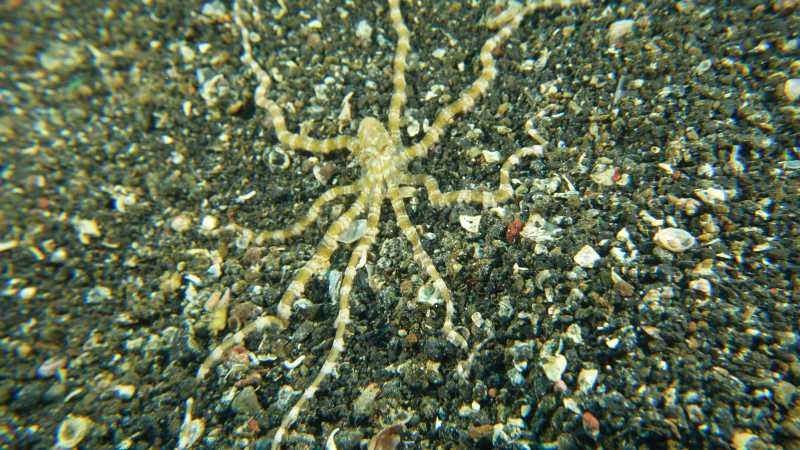
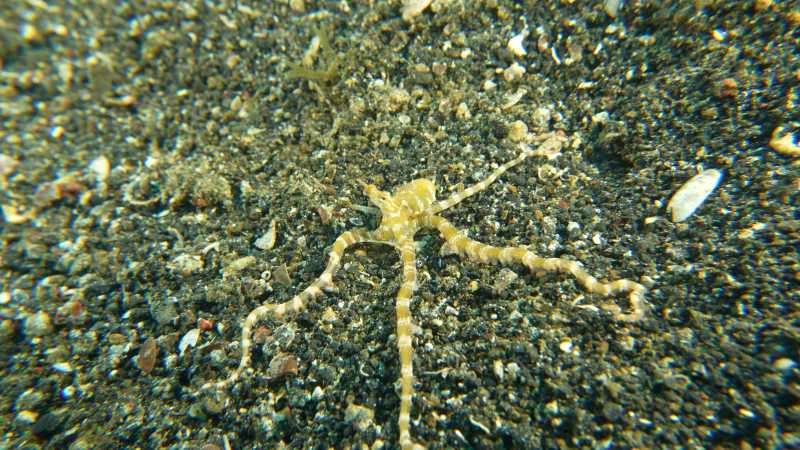
Wunderpus photogenicus. Also known as the Mimic Octopus.
This is a spectacular long-armed octopus species found in shallow waters over soft sediment in the Indomalayan Archipelago. The species is characterized by a solid, dramatic color pattern of white bands and spots on a brownish-red background. Each individual has a unique pattern of white spots on its head.
Wunderpus photogenicus
The Wonderpus is known for its intelligence and ability to mimic other sea creatures for defense or attack. It doesn't always like divers; it can also bury itself.

The Problem with Focus

With a camera, you reach the limit of just a few millimeters of tolerance to the optimal focus point. Anything beyond that will be blurry. It's difficult because I'm free-swimming. The currents move not only me, but also the small creatures. A tripod would sometimes be helpful. I don't have one, because my diving gear is already heavy enough.

It's somewhat easier with pure photography using flash. A higher resolution than with video is also easier to achieve.

Video is more difficult because the tiny creatures need to be in focus for a longer period of time.

But moving images show much more action!

My Photographic Equipment

For quite some time now, I've been using a Sony A1 as my camera for indoor use. It now also has a Nauticam underwater housing. For lenses, I use a 60mm zoom and two macro close-up lenses, which I can attach underwater as needed. I also use two X-Adventurer lights. They are suitable for video and flash photography.

For video post-processing, I use DaVinci Resolve from Blackmagic. For photos, I use Lightroom and Photoshop from Adobe.

View - Fullscreen

You can watch videos in full screen. To do this, click the square in the bottom right corner of the video:

VideoFullscreen

Technical Information

The video is created in high compression in MP4 - H.265 format. A current codec is required. Older video players and PCs may not be able to display it.

If you only hear the audio, you need to install support for the HEVC video format.

For Windows, this extension is available in the Microsoft Store. It costs one Swiss franc.
The extension is also included free of charge in the VLC media player: VideoLAN.org